


Green Technology and Sustainability Market Analysis Reveals Emerging Growth Drivers Worldwide
- Ajaykumar Patil
- 1 hour ago
- 5 min read

Introduction
The global green technology and sustainability market is undergoing remarkable transformation as governments, businesses, and consumers increasingly prioritize environmentally responsible solutions. Green technology refers to innovative products, systems, and practices designed to minimize environmental impact, conserve natural resources, and promote sustainable development.
As climate change concerns intensify and energy costs continue to rise, industries across the globe are rapidly adopting sustainable technologies to reduce carbon footprints and improve operational efficiency. Green technology spans multiple sectors, including renewable energy, energy-efficient systems, waste management, green building solutions, carbon management, sustainable agriculture, and smart transportation.
The rising pressure to comply with environmental regulations, coupled with growing environmental, social, and governance (ESG) commitments among corporations, is accelerating market growth. Businesses are increasingly integrating sustainability initiatives into their long-term strategies to enhance resilience, improve brand reputation, and meet investor expectations.
Market Insights
The green technology and sustainability market is witnessing strong momentum due to increasing investments in clean energy systems, smart infrastructure, and environmentally sustainable innovations. Organizations worldwide are actively adopting technologies that improve resource efficiency, reduce emissions, and support long-term environmental sustainability.
One of the major trends shaping the market is the widespread integration of digital technologies such as artificial intelligence (AI), Internet of Things (IoT), and big data analytics into sustainability initiatives. These technologies are enabling organizations to optimize energy consumption, monitor carbon emissions, and improve waste management systems.
Additionally, increasing public awareness regarding climate change and environmental conservation is creating strong demand for eco-friendly products and renewable energy solutions. Governments are also offering tax incentives, subsidies, and policy support to accelerate the adoption of sustainable technologies.
The transition toward circular economy models, where materials are reused and waste generation is minimized, is further creating opportunities for market expansion.
Get Your FREE Sample Report Instantly – Click Now: https://www.persistencemarketresearch.com/samples/36600
How Big is the Green Technology and Sustainability Market?
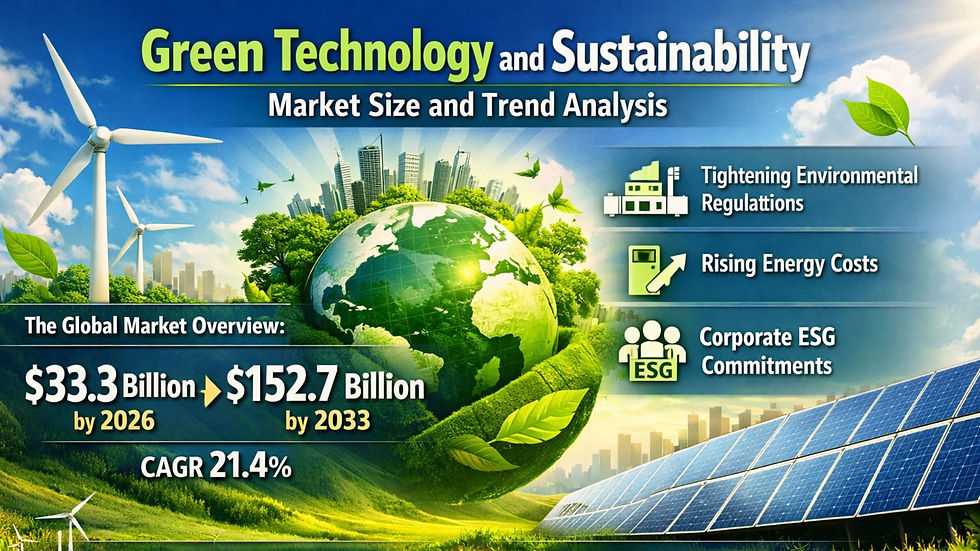
The global green technology and sustainability market size is expected to be valued at US$33.3 billion in 2026 and is projected to reach approximately US$152.7 billion by 2033, expanding at a robust CAGR of 21.4% during the forecast period from 2026 to 2033.
This impressive growth is being fueled by tightening environmental regulations worldwide, increasing pressure from rising energy costs, and a surge in corporate ESG commitments. Businesses across industries are investing heavily in sustainable solutions to improve environmental performance, reduce costs, and align with global sustainability goals.
The increasing adoption of renewable energy technologies, energy-efficient systems, carbon reduction solutions, and sustainable manufacturing practices is expected to further strengthen market expansion throughout the forecast period.
Key Market Drivers
Tightening Global Environmental Regulations
Governments worldwide are implementing stricter regulations to reduce greenhouse gas emissions and environmental degradation. Industries are being required to adopt cleaner technologies and sustainable operational practices, significantly boosting demand for green technologies.
Carbon neutrality targets and climate-focused policies are encouraging companies to invest in sustainable infrastructure and low-emission technologies.
Rising Energy Cost Pressures
Increasing global energy prices are encouraging organizations to adopt energy-efficient technologies to reduce operational expenses. Businesses are increasingly investing in renewable energy systems, smart energy management solutions, and sustainable infrastructure to improve cost efficiency.
Energy optimization technologies are becoming critical for industries seeking long-term profitability.
Growing Corporate ESG Commitments
Environmental, social, and governance (ESG) strategies have become central to corporate decision-making. Investors, regulators, and consumers are demanding stronger sustainability commitments from organizations.
As a result, companies are actively investing in carbon tracking systems, renewable energy adoption, sustainable supply chains, and green manufacturing initiatives.
Technological Advancements in Sustainability Solutions
The integration of smart technologies such as AI, blockchain, and IoT is enhancing sustainability performance. Smart grids, predictive maintenance, automated energy management, and intelligent waste reduction systems are improving operational efficiency and environmental outcomes.
Business Opportunities in the Market
The growing emphasis on sustainability is creating substantial business opportunities across multiple industries.
Renewable energy technologies, including solar, wind, and hydrogen-based systems, represent major investment opportunities. Businesses involved in energy storage, carbon capture, waste recycling, and water conservation technologies are expected to witness strong growth prospects.
The rise of smart cities is also creating opportunities for green infrastructure developers and sustainable transportation providers. Increasing adoption of electric vehicles (EVs), sustainable buildings, and eco-friendly industrial technologies is likely to generate new revenue streams for market participants.
Furthermore, ESG consulting services, carbon accounting software, and sustainability reporting platforms are emerging as high-growth business segments due to increasing regulatory requirements and investor scrutiny.
Companies that prioritize innovation and sustainability-focused product development are expected to gain a competitive advantage in this rapidly expanding market.
Regional Analysis
North America
North America holds a significant share of the green technology and sustainability market due to stringent environmental policies, high renewable energy adoption, and strong ESG investment activity. The United States and Canada continue to invest heavily in clean energy and smart infrastructure projects.
Europe
Europe remains one of the leading regions due to ambitious carbon neutrality goals and aggressive climate regulations. Countries such as Germany, France, and the United Kingdom are focusing heavily on renewable energy expansion and sustainable industrial transformation.
Asia Pacific
Asia Pacific is expected to witness the fastest growth during the forecast period. Rapid urbanization, industrialization, and increasing government support for renewable energy projects are fueling market expansion.
Countries such as China, India, Japan, and South Korea are making significant investments in green infrastructure, electric mobility, and sustainable manufacturing.
Latin America
Latin America is gradually emerging as a promising market due to rising renewable energy investments and increasing awareness regarding environmental sustainability.
Middle East & Africa
The Middle East & Africa region is seeing growing adoption of sustainable technologies, particularly in renewable energy, desalination systems, and smart urban infrastructure.
Key Players in the Green Technology and Sustainability Market
Several major companies are actively investing in innovation, partnerships, and sustainable product development to strengthen their market position. Key market participants include:
Schneider Electric
Siemens AG
IBM Corporation
Microsoft Corporation
General Electric
Honeywell International Inc.
Engie
Enel Green Power
ABB Ltd.
Tesla Inc.
These companies are focusing on renewable energy technologies, smart energy systems, carbon management, and digital sustainability solutions to capitalize on market opportunities.
Market Segmentation
The green technology and sustainability market can be segmented based on technology, application, and end-use industry.
By Technology
Renewable Energy Technologies
Energy-efficient Systems
Green Building Technologies
Carbon Footprint Management
Water Management Solutions
Waste Management Technologies
By Application
Energy Generation
Transportation
Manufacturing
Agriculture
Buildings & Construction
Industrial Processes
By End-use Industry
Energy & Utilities
Manufacturing
Transportation & Logistics
Agriculture
Residential & Commercial Buildings
Government & Public Sector
By Region
North America
Europe
Asia Pacific
Latin America
Middle East & Africa
Conclusion
The global green technology and sustainability market is positioned for exponential growth as industries, governments, and consumers intensify efforts to address environmental challenges and climate change.
With the market projected to grow from US$33.3 billion in 2026 to US$152.7 billion by 2033, sustainable technologies are expected to become an integral part of industrial operations and economic development strategies worldwide.
Driven by stricter environmental regulations, rising energy cost pressures, and growing corporate ESG commitments, companies investing in innovation, digital sustainability solutions, and renewable technologies are likely to secure long-term competitive advantages in this rapidly evolving market.
Explore the Latest Trending Research Reports:


Comments