


Power Quality Instruments Market Applications Strengthen in Data Centers and Utilities
- Ajaykumar Patil
- Dec 8, 2025
- 5 min read

Introduction: Understanding the Rising Importance of Power Quality
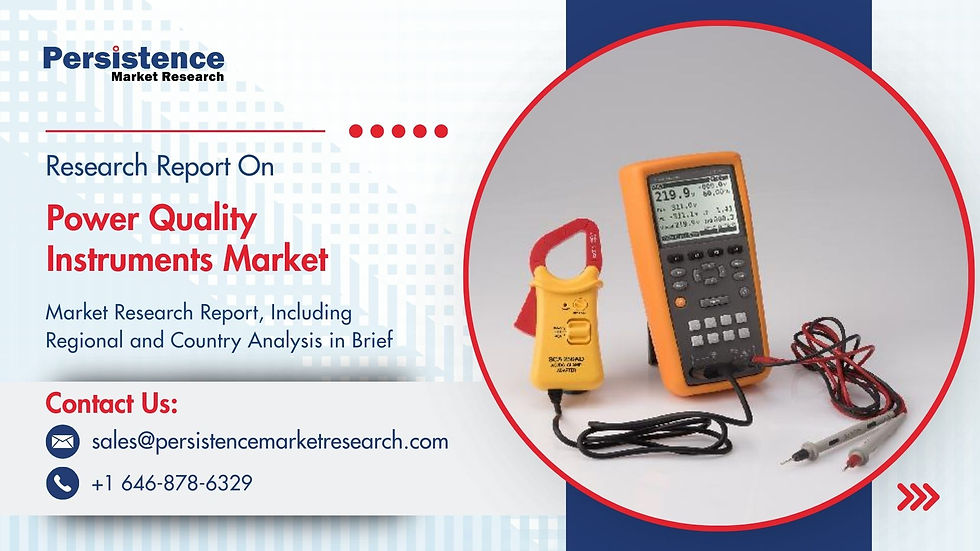
The global transition toward digitalization, automation, and electrification is reshaping industries, making power quality more critical than ever. From manufacturing plants and data centers to commercial buildings and utility networks, the stability and reliability of power supply directly influence operational efficiency, safety, and productivity. Power quality instruments—devices used to monitor, analyze, and improve the characteristics of electrical power—have become essential tools for modern infrastructure. These instruments help identify disturbances, reduce downtime, and prevent costly equipment failures, making them indispensable in today’s power-intensive environment.
Market Overview: Growth Trajectory and Future Potential
The rising demand for uninterrupted and clean power across industrial, commercial, and residential sectors is fueling the expansion of the power quality instruments market. Increasing dependence on sensitive electronic equipment, along with the integration of renewable energy sources, has further amplified the need for monitoring and controlling power fluctuations. According to a recent report by Persistence Market Research, the power quality instruments market is poised for strong growth over the coming years. The report highlights that the global market is projected to rise from US$ 39.5 billion in 2024 to US$ 59.4 billion by 2031, reflecting a compound annual growth rate (CAGR) of 6% during the forecast period. This upward trajectory signifies mounting investment in power quality solutions as industries seek to minimize disruptions and maintain energy efficiency.
Why Are Power Quality Instruments Essential for Modern Industrial Operations?
Power quality instruments are essential for modern industrial operations because they help detect and mitigate voltage sags, surges, harmonics, and other electrical disturbances that can disrupt equipment performance. With industries increasingly adopting automation, robotics, and digital control systems, even minor power fluctuations can lead to production downtime, equipment malfunction, and financial losses. These instruments ensure stable power flow, optimize energy usage, and protect critical assets by providing real-time data and diagnostics. Additionally, they support predictive maintenance strategies, helping industries reduce operational risks, extend machinery lifespan, and enhance overall productivity in an increasingly electrified environment.
Key Market Drivers: What’s Fueling Market Growth
Several forces are contributing to the rising demand for power quality instruments worldwide. One of the primary drivers is the rapid adoption of automation and digital technologies across manufacturing, healthcare, telecommunications, and IT sectors. These advanced systems rely heavily on consistent and disturbance-free power to function efficiently. Even slight variations in voltage or frequency can cause malfunctions, making real-time monitoring essential.
Another major driver is the growing integration of renewable energy sources such as solar and wind. While these energy systems support sustainability goals, their intermittent nature can introduce power instability and fluctuations into the grid. Power quality instruments play a crucial role in analyzing, balancing, and mitigating such disturbances, ensuring smooth operation.
Moreover, the increasing use of electric vehicles (EVs), smart home devices, and high-load appliances has heightened the demand for robust grid infrastructure. As utilities upgrade their networks to meet rising electricity consumption, power quality monitoring becomes a necessary component for maintaining stability and efficiency.
Technological Advancements: Innovations Transforming the Market
Advancements in technology are transforming power quality instruments into more intelligent, connected, and user-friendly solutions. Modern devices now incorporate IoT connectivity, cloud-based analytics, and AI-driven diagnostics, allowing for remote monitoring and automated reporting. These innovations help technicians identify issues faster, predict system failures, and implement corrective measures before disruptions occur.
Additionally, smart meters and digital fault recorders have become increasingly sophisticated, offering granular insights into energy usage, peak loads, and waveform distortions. Portable analyzers and handheld devices also continue to evolve, becoming more accurate, lightweight, and accessible for field engineers.
The integration of advanced sensors, high-speed processors, and intuitive software interfaces has further improved the accuracy and usability of power quality instruments. These technological enhancements are enabling industries to adopt predictive maintenance practices, reducing downtime and operational costs.
Segment Analysis: Product Types and Applications
The power quality instruments market is broadly segmented into analyzers, meters, recorders, and monitoring devices, each serving different operational needs. Power quality analyzers remain a dominant segment due to their ability to measure diverse parameters such as harmonics, transients, and imbalance. They are widely used in manufacturing facilities, hospitals, data centers, and utility networks where precise diagnostics are essential.
Power quality meters, on the other hand, are gaining popularity for continuous monitoring applications. They help track voltage variations and energy consumption, making them indispensable for commercial buildings and industrial plants seeking energy efficiency.
Digital fault recorders and disturbance analyzers are widely used in utility grids to capture transient events and analyze disruptions. As grid modernization continues, this segment is expected to grow significantly. The application areas for these instruments span industries such as oil & gas, automotive, aerospace, telecommunications, and renewable energy, each requiring specialized solutions to ensure stable electrical performance.
Regional Insights: Leading Markets and Growth Hotspots
North America currently leads the power quality instruments market, driven by high industrial automation, strong adoption of renewable energy, and stringent power quality regulations. The region also benefits from advanced grid infrastructure and a strong presence of leading solution providers.
Europe follows closely, supported by its emphasis on energy efficiency, sustainable energy integration, and modernization of aging utility systems. Countries like Germany, the UK, and France are actively investing in power monitoring technologies to support industrial growth and environmental goals.
Asia Pacific is emerging as the fastest-growing region due to rapid industrialization, urbanization, and expanding manufacturing sectors. Countries such as China, India, Japan, and South Korea are witnessing rising electricity consumption and increased adoption of smart infrastructure, driving demand for power quality instruments. The growth of renewable energy projects further intensifies the need for robust monitoring solutions.
Challenges Facing the Market
Despite strong growth prospects, the power quality instruments market faces certain challenges. High installation and maintenance costs can deter small-scale enterprises, especially in developing countries. Lack of technical expertise and awareness about the long-term benefits of power quality monitoring also hinders market penetration.
Additionally, integrating advanced monitoring systems into older grid infrastructure remains a challenge in many regions. Data management complexities and cybersecurity concerns are also emerging issues as instruments become more connected and digitally integrated.
Future Outlook: Opportunities on the Horizon
The future of the power quality instruments market looks promising, with significant opportunities emerging from grid modernization, industrial automation, and renewable energy expansion. Advancements in AI, machine learning, and edge analytics are expected to revolutionize power monitoring, enabling predictive and self-healing electrical systems.
The growing emphasis on sustainability and energy efficiency will drive businesses to adopt advanced monitoring tools to reduce losses and enhance performance. As smart cities and electric mobility continue to evolve, power quality instruments will play a crucial role in ensuring stable and intelligent electrical infrastructure.
Conclusion: A Market Poised for Steady Growth
The power quality instruments market is set to experience steady growth as industries and utilities prioritize reliability, efficiency, and sustainability in their electrical systems. With market value projected to rise from US$ 39.5 billion in 2024 to US$ 59.4 billion by 2031, supported by a 6% CAGR, the future of this industry appears highly promising. As technological advancements unfold and global energy demands rise, power quality instruments will remain essential tools for building resilient, efficient, and future-ready power networks.
Explore the Latest Trending Research Reports:


Comments