


Renewable Aviation Fuel Market Innovation Supported by Strategic Industry Partnerships
- Ajaykumar Patil
- Dec 2, 2025
- 5 min read

Introduction: The Urgent Need for Cleaner Aviation Solutions
The aviation industry is at a pivotal moment as global pressure mounts to reduce carbon emissions and transition toward more sustainable energy sources. Traditional jet fuel, derived from fossil fuels, significantly contributes to greenhouse gas emissions, making the search for cleaner alternatives a top priority. Renewable aviation fuel, also known as Sustainable Aviation Fuel (SAF), has emerged as a promising solution for achieving net-zero goals, reducing dependency on non-renewable resources, and supporting long-term environmental stability. As governments, airlines, and fuel producers accelerate investments in SAF, the market is witnessing unprecedented growth and technological advancements.
Market Outlook: A Rapidly Expanding Global Industry
The renewable aviation fuel market is experiencing exponential expansion, driven by rising environmental concerns, advancements in production technologies, and strong regulatory support. According to a detailed market analysis published by Persistence Market Research, the global renewable aviation fuel market is expected to be valued at US$ 2.1 billion in 2025. Looking ahead, the market is estimated to surge dramatically, reaching a remarkable US$ 53.8 billion by 2032. This extraordinary growth reflects a record-breaking compound annual growth rate (CAGR) of 47.8% during the forecast window of 2025 to 2032. The staggering pace of this expansion highlights the increasing global commitment to decarbonizing air travel and adopting cleaner fuel alternatives.
Why Is Renewable Aviation Fuel Important for the Future of Air Travel?
Renewable aviation fuel is crucial for the future of air travel because it significantly reduces carbon emissions without requiring major aircraft modifications. As airlines face growing pressure from governments, environmental agencies, and passengers to adopt greener practices, SAF offers an immediate and scalable solution. It can cut lifecycle emissions by up to 80%, making it one of the most efficient pathways to achieving net-zero aviation goals. Additionally, renewable aviation fuel enhances energy security by reducing reliance on fossil fuels and diversifying the energy supply. As global air travel demand rises, SAF is essential for balancing growth with sustainability.
Get Your FREE Sample Report Instantly – Click Now: https://www.persistencemarketresearch.com/samples/35925
Key Growth Drivers: What’s Propelling the Renewable Aviation Fuel Market?
One of the most powerful drivers behind the rapid growth of the renewable aviation fuel market is the global push to meet international climate targets. Organizations like the International Civil Aviation Organization (ICAO) and International Air Transport Association (IATA) have outlined ambitious strategies such as CORSIA (Carbon Offsetting and Reduction Scheme for International Aviation), which encourages airlines to adopt SAF to reduce emissions. These frameworks have accelerated the adoption of renewable fuels and stimulated investment in large-scale production facilities.
Another major growth factor is the commitment from leading airlines and aviation companies. Several global carriers have already pledged to increase SAF usage over the next decade, and some have formed strategic partnerships with fuel producers to secure long-term supplies. The expanding network of supply agreements and the introduction of government incentives, tax credits, and subsidies continue to lower the cost of SAF production and encourage technology adoption.
Production Technologies and Feedstock Innovations
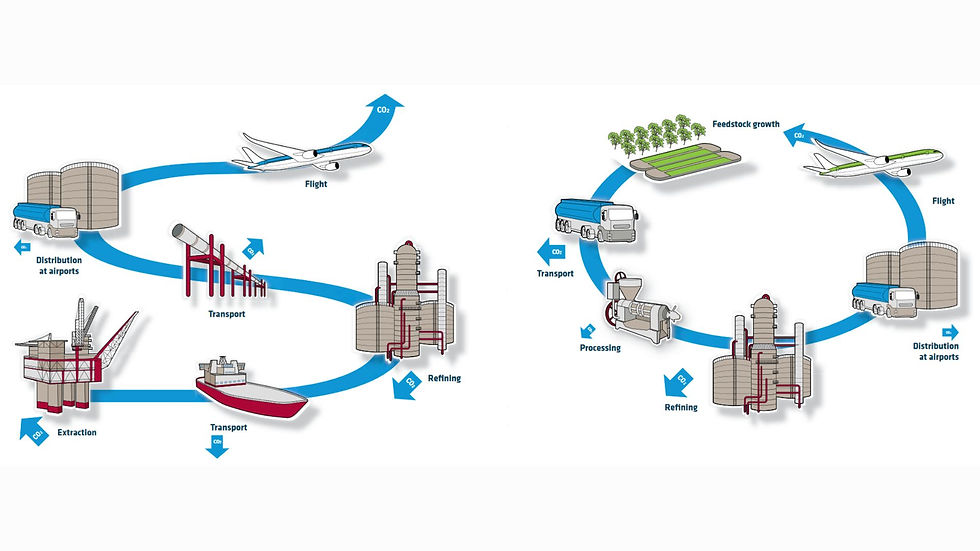
Renewable aviation fuel can be produced using several innovative technologies, including Hydroprocessed Esters and Fatty Acids (HEFA), Fischer-Tropsch synthesis, Alcohol-to-Jet (AtJ), and Pyrolysis. Among these, HEFA remains the most commercially viable due to its scalability and compatibility with existing refinery infrastructure. As investment in research and development grows, new pathways are emerging, focusing on agricultural residues, waste oils, municipal solid waste, and even carbon captured from industrial emissions.
Feedstock diversification is becoming a vital strategy for expanding production capacity. While used cooking oil and animal fats are currently dominant, the future will rely heavily on non-food biomass, algae, and synthetic fuels derived from captured CO₂ and green hydrogen. These innovations are essential for reducing production costs and scaling availability across global markets.
Regulatory Support and Policy Frameworks
Government policies play a crucial role in shaping the renewable aviation fuel market. Regions such as Europe and North America have implemented robust mandates requiring minimum SAF blends in commercial flights. For example, the European Union’s ReFuelEU Aviation initiative is pushing for mandatory SAF blending percentages, while the United States is supporting biofuel expansion through tax incentives like the SAF credit under the Inflation Reduction Act.
Countries across Asia-Pacific, including Japan, Singapore, and India, are also investing heavily in refining infrastructure and adopting national roadmaps to integrate SAF into their aviation ecosystem. These coordinated policy efforts are essential for bridging the price gap between conventional jet fuel and renewable alternatives.
Challenges Hindering Widespread Adoption
Despite its remarkable growth potential, the renewable aviation fuel market faces several challenges. One major limitation is the high production cost, which remains significantly above conventional jet fuel prices. This cost gap is attributed to limited feedstock availability, high conversion expenses, and the need for advanced refining technologies. Additionally, infrastructure constraints and slow certification processes delay the scalability of SAF across global airports.
Another challenge is the competition for bio-based feedstock between aviation fuel and other renewable industries, such as biodiesel and renewable diesel. Ensuring sufficient raw materials to meet future demand remains a key concern for producers and governments alike.
Regional Market Dynamics: Where Growth Is Concentrated
Europe remains a global leader in renewable aviation fuel adoption due to strict emission regulations and high sustainability standards. Countries such as Germany, France, the Netherlands, and the UK are rapidly developing SAF production clusters and deploying large-scale blending mandates.
North America follows closely, driven by strong government incentives and growing airline commitments. The United States, with its extensive refining infrastructure, is expected to become a major global producer of SAF in the coming decade.
The Asia-Pacific region is emerging as the fastest-growing market, supported by rising air travel demand, increasing energy security concerns, and strategic investments by countries such as China, Japan, South Korea, and Singapore. With expanding airport networks and booming aviation industries, Asia-Pacific is poised to play a transformative role in the global SAF landscape.
Future Outlook: A New Era of Sustainable Aviation
The future of the renewable aviation fuel market looks exceptionally promising as technology accelerates and global climate targets become more ambitious. Increasing collaboration across governments, research institutions, energy companies, and airline operators will play a crucial role in overcoming current challenges and scaling production. Emerging innovations such as power-to-liquid fuels, green hydrogen integration, and advanced bio-refinery technologies will further reduce costs and boost global availability.
With a projected CAGR of 47.8% and market value expected to rise dramatically from US$ 2.1 billion in 2025 to US$ 53.8 billion by 2032, renewable aviation fuel is positioned to redefine the aviation industry. As sustainability becomes a non-negotiable priority, SAF will be instrumental in achieving a cleaner, more efficient, and environmentally responsible future for global air travel.
Conclusion: Charting the Path Toward Zero-Emission Aviation
The renewable aviation fuel market represents one of the most powerful levers for decarbonizing air transportation. With the combined force of global policy support, increasing airline adoption, and rapid technological advancements, the industry is set for exceptional growth. While challenges remain, the momentum behind SAF innovation is stronger than ever. As the world moves towards a net-zero future, renewable aviation fuel will be the cornerstone of sustainable aviation, ensuring that the industry continues to soar without compromising the planet.
Explore the Latest Trending Research Reports:


Comments