


Sodium Propionate Market Innovations Drive Efficiency in Preservation Technologies
- Ajaykumar Patil
- May 15
- 6 min read

Introduction
The global food industry is undergoing a major transformation as consumers increasingly demand products that are safe, convenient, long-lasting, and minimally affected by microbial spoilage. This shift has significantly increased the importance of food preservatives, especially those capable of maintaining freshness while meeting stringent food safety standards. Among these preservatives, sodium propionate has emerged as a widely used and highly effective ingredient across multiple industries.
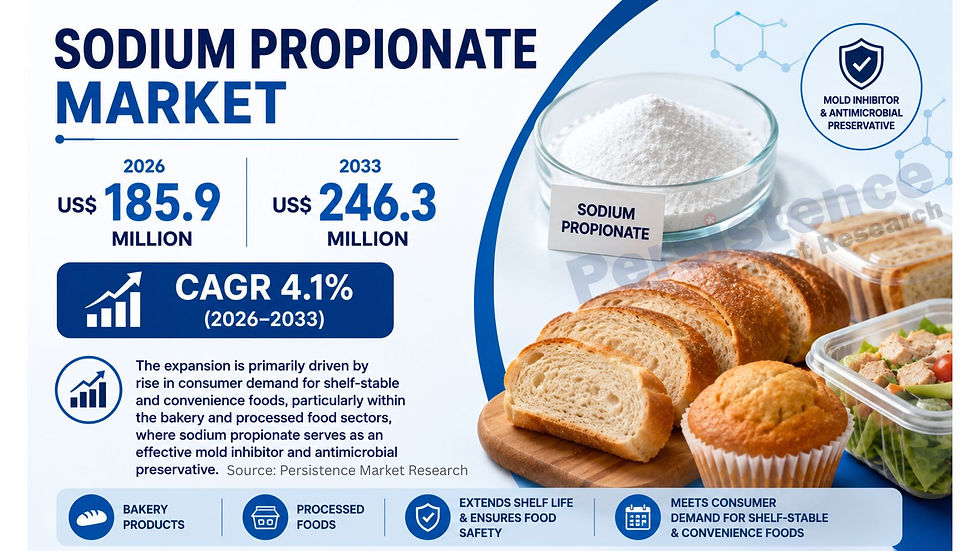
According to the latest study by Persistence Market Research, the global sodium propionate market is expected to be valued at US$ 185.9 million in 2026 and is projected to reach US$ 246.3 million by 2033, expanding at a CAGR of 4.1% during the forecast period. The market’s growth is primarily fueled by rising consumption of processed and convenience foods, especially bakery products where sodium propionate acts as an efficient mold inhibitor and antimicrobial preservative.
Understanding Sodium Propionate and Its Industrial Importance
Sodium propionate is the sodium salt of propionic acid and is commonly used as a food additive due to its excellent antifungal and antibacterial properties. It effectively prevents the growth of mold and certain bacteria, thereby extending the shelf life of food products. The compound is particularly useful in moisture-rich foods that are susceptible to microbial contamination.
Apart from food preservation, sodium propionate also finds applications in pharmaceuticals, animal feed, agriculture, and cosmetics. Its multifunctional nature and cost-effectiveness have made it a preferred preservative solution across several industries.
The growing global concern regarding food waste and spoilage has further strengthened the demand for reliable preservatives such as sodium propionate. Manufacturers are increasingly integrating such additives into food production processes to improve product stability and reduce losses during transportation and storage.
Rising Consumption of Bakery Products Driving Market Expansion
One of the most significant growth drivers for the sodium propionate market is the rapid increase in bakery product consumption worldwide. Bread, cakes, pastries, tortillas, buns, and other baked items are highly vulnerable to mold growth due to their moisture content. Sodium propionate helps maintain freshness and extends the usability of these products without altering taste or texture.
The busy lifestyles of urban consumers have increased the popularity of ready-to-eat and packaged bakery products. Consumers prefer foods that require minimal preparation while still offering freshness and quality. This trend has substantially increased the adoption of sodium propionate in commercial bakeries and food processing facilities.
Emerging economies are also witnessing strong growth in organized retail chains and packaged food industries, creating additional opportunities for preservative manufacturers. As supermarkets and hypermarkets expand their footprint, the need for products with longer shelf lives continues to rise.
Growth of Convenience Foods Supporting Demand
The growing preference for convenience foods is another major factor supporting market growth. Frozen meals, packaged snacks, processed meats, and ready-to-cook food products rely heavily on preservatives to maintain safety and quality during storage and distribution.
Urbanization, changing dietary patterns, and increasing disposable incomes have contributed to the rapid growth of convenience food consumption globally. Sodium propionate plays a vital role in preventing microbial contamination and ensuring product consistency across large-scale food manufacturing operations.
Additionally, the expansion of online food delivery services and modern retail infrastructure has further increased the demand for packaged foods with enhanced shelf stability. Food manufacturers are prioritizing preservative solutions that comply with regulatory standards while effectively maintaining product freshness.
Expanding Applications Beyond Food Industry
Although food preservation remains the primary application area, sodium propionate is gradually gaining traction in other industries as well.
Animal Feed Industry
In the animal feed sector, sodium propionate is used to inhibit mold growth in stored feed products. It helps preserve nutritional quality while reducing the risk of fungal contamination that could negatively impact livestock health. Rising awareness regarding animal nutrition and feed safety is expected to support additional demand in this segment.
Pharmaceutical Applications
The pharmaceutical industry utilizes sodium propionate for its antimicrobial properties in selected medicinal formulations. Increasing focus on product stability and contamination prevention is encouraging wider adoption in healthcare applications.
Agricultural Uses
In agriculture, sodium propionate is sometimes used to protect stored grains and silage from fungal growth. As agricultural storage infrastructure expands globally, demand for effective preservation chemicals is expected to increase steadily.
Consumer Preference for Food Safety and Quality
Food safety remains a top priority for consumers and regulatory authorities alike. Increasing awareness about microbial contamination and foodborne illnesses has encouraged manufacturers to invest in reliable preservation technologies.
Sodium propionate offers several advantages in this regard:
Effective mold inhibition
Extended shelf life
Improved product stability
Cost-efficient preservation
Compatibility with multiple food formulations
Consumers are also becoming more conscious about reducing food waste. Products that remain fresh for longer periods are increasingly preferred, particularly in regions where supply chain efficiency remains a challenge.
Moreover, governments across various countries are implementing stricter food safety regulations, encouraging manufacturers to adopt approved preservative solutions that comply with industry standards.
Regional Outlook of the Sodium Propionate Market
North America
North America remains a significant market for sodium propionate due to the strong presence of processed food manufacturers and commercial bakery chains. The region’s mature food processing industry and high consumption of packaged foods continue to support steady demand.
The United States leads regional consumption owing to increasing demand for convenience foods and advanced food preservation technologies.
Europe
Europe also represents a prominent market due to growing emphasis on food quality, safety, and waste reduction. Countries such as Germany, France, and the United Kingdom have well-established bakery industries that heavily utilize sodium propionate.
Stringent food safety regulations in the European Union are encouraging manufacturers to use effective and approved preservatives to maintain product integrity.
Asia-Pacific
The Asia-Pacific region is expected to witness the fastest growth during the forecast period. Rapid urbanization, population growth, expanding middle-class income, and increasing consumption of packaged foods are major contributing factors.
Countries such as China and India are experiencing strong growth in bakery and processed food industries, creating substantial opportunities for sodium propionate manufacturers.
The expansion of modern retail channels and increasing investments in food processing infrastructure are also accelerating market development across the region.
Latin America and Middle East & Africa
These regions are gradually emerging as promising markets due to improving food distribution systems and rising consumer awareness regarding packaged food safety. Growth in organized retail and urban food consumption patterns is expected to contribute to future market expansion.
Technological Advancements and Product Innovation
Manufacturers are increasingly focusing on product innovation and advanced production technologies to enhance efficiency and meet evolving consumer demands. Research efforts are aimed at improving preservative performance while ensuring compliance with food safety regulations.
Companies are also exploring clean-label solutions and optimized formulations that align with changing consumer preferences. Although synthetic preservatives continue to dominate due to their effectiveness and affordability, growing interest in natural preservation systems may influence future product development strategies.
Sustainability has also become a major focus area for manufacturers. Efficient production methods, waste reduction initiatives, and environmentally responsible sourcing practices are gaining importance across the chemical and food industries.
Competitive Landscape and Key Players
The sodium propionate market is moderately competitive, with several global and regional manufacturers focusing on production expansion, product quality, and strategic partnerships to strengthen market presence.
Key players operating in the global sodium propionate market include:
BASF SE
Kemin Industries
Niacet Corporation
Macco Organiques Inc.
Prathista Industries Limited
AB Mauri
Perstorp Holding AB
Eastman Chemical Company
Impextraco NV
A.M Food Chemical Co. Limited
These companies are investing in research and development activities, expanding production capacities, and strengthening global distribution networks to capitalize on growing demand from food and industrial sectors.
Challenges Facing the Market
Despite favorable growth prospects, the sodium propionate market faces certain challenges. Increasing consumer preference for clean-label and natural food products may limit the growth of synthetic preservatives in some regions.
Regulatory scrutiny regarding food additives is also becoming more stringent. Manufacturers must continuously ensure compliance with evolving international food safety standards and labeling requirements.
Additionally, fluctuations in raw material prices and supply chain disruptions could impact production costs and profit margins for market participants.
However, ongoing innovation and the growing need for effective food preservation are expected to support long-term market stability.
Future Outlook
The future of the sodium propionate market appears promising as global food consumption patterns continue evolving toward convenience, safety, and extended shelf life. The expanding bakery industry, rising processed food demand, and growing awareness regarding food waste reduction are expected to remain key growth drivers.
Emerging markets are likely to provide lucrative opportunities for manufacturers due to rapid industrialization, urbanization, and expansion of organized food retail sectors. Furthermore, advancements in preservative technologies and increasing investments in food processing infrastructure are expected to strengthen market growth over the coming years.
As industries continue prioritizing product quality, food safety, and supply chain efficiency, sodium propionate is expected to maintain its critical role as a reliable preservative solution across global markets.
Explore the Latest Trending Research Report:


Comments