


Solar Charge Controller Market Revenue Growth Driven by Energy Storage Integration
- Ajaykumar Patil
- Oct 14, 2025
- 5 min read

Introduction: The Backbone of Solar Energy Systems
As the global focus on renewable energy intensifies, solar power continues to dominate as one of the most promising and accessible clean energy sources. At the heart of every efficient solar power system lies a critical yet often overlooked component — the solar charge controller. This essential device regulates the flow of energy between solar panels, batteries, and loads, ensuring optimal performance, safety, and longevity of the system. With increasing adoption of solar power in residential, commercial, and industrial sectors, the demand for advanced solar charge controllers has witnessed steady growth across the globe.
Market Overview: Growth Outlook and Revenue Insights
The solar charge controller market has seen a substantial surge in recent years, largely due to expanding solar installations and rising awareness about the importance of efficient energy management. Governments worldwide are encouraging renewable energy adoption through tax incentives, subsidies, and supportive regulations, further propelling market growth.
According to the Persistence Market Research report, the global solar charge controller market size is projected to rise from US$ 2,397.4 Mn in 2025 to US$ 5,474.2 Mn by 2032. It is anticipated to witness a robust CAGR of 12.6% during the forecast period from 2025 to 2032. This impressive growth highlights the increasing integration of solar technologies across energy systems, homes, and industries, driving innovation and efficiency in power conversion and storage.
What Is a Solar Charge Controller and Why Is It Important?
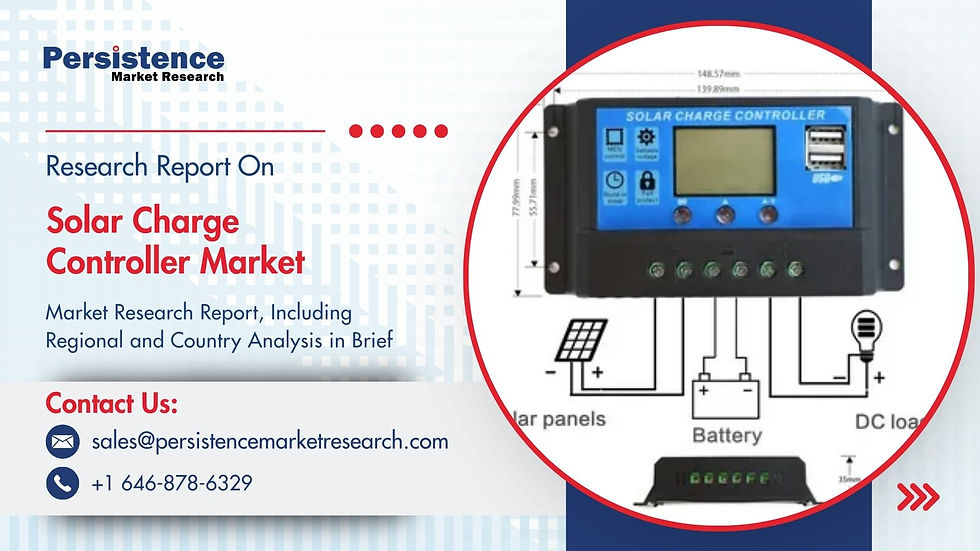
A solar charge controller is a device that manages the voltage and current coming from solar panels to the battery. It prevents overcharging and deep discharging, ensuring the battery’s safety and lifespan. These controllers are vital in solar energy systems as they stabilize the energy flow and maximize energy efficiency. Without them, batteries could be damaged due to inconsistent voltage levels. With the global shift toward renewable energy and the growing reliance on off-grid systems, solar charge controllers have become indispensable for ensuring stable, efficient, and sustainable power generation.
Get a Sample PDF Brochure of the Report (Use Corporate Email ID for a Quick Response): https://www.persistencemarketresearch.com/samples/18805
Market Dynamics: Key Drivers Behind the Growth
The growing demand for renewable energy sources is the primary driver fueling the expansion of the solar charge controller market. As solar energy becomes increasingly cost-effective and accessible, both developed and developing nations are investing heavily in solar infrastructure. This trend is particularly evident in rural electrification projects, where off-grid solar systems rely on charge controllers to ensure efficient energy use and battery management.
Technological advancements are also reshaping the market landscape. The development of Maximum Power Point Tracking (MPPT) charge controllers has significantly improved system efficiency by enabling optimal power extraction from solar panels. These innovations are replacing older Pulse Width Modulation (PWM) models, especially in large-scale and commercial installations where efficiency gains directly translate to cost savings.
Additionally, government initiatives supporting solar energy adoption—such as the European Green Deal, the U.S. Solar Investment Tax Credit, and India’s National Solar Mission—are boosting deployment rates. These policies encourage both residential and commercial users to adopt solar systems equipped with advanced charge controllers.
Segmentation Analysis: Understanding the Market Structure
The solar charge controller market can be segmented based on technology, application, and end use.
By Technology: The market is mainly divided into PWM and MPPT charge controllers. While PWM controllers are cost-effective and suitable for smaller systems, MPPT controllers dominate the market due to their higher energy conversion efficiency and suitability for large-scale applications.
By Application: Off-grid solar systems remain the largest segment, especially in remote and rural areas lacking access to centralized power grids. However, hybrid and grid-tied systems are gaining popularity as more users seek backup power solutions and energy storage options.
By End Use: The key end users include residential, commercial, and industrial sectors. The commercial segment is witnessing rapid growth as industries invest in renewable solutions to reduce operational costs and meet sustainability goals.
Technological Advancements: Transforming the Market Landscape
The solar charge controller market is evolving rapidly with technological innovations that enhance energy conversion, monitoring, and system reliability. Modern controllers now feature smart monitoring systems that provide real-time data on performance, energy output, and battery status through IoT-enabled platforms.
Artificial intelligence (AI) and machine learning (ML) are also finding their way into solar systems, allowing predictive maintenance and adaptive energy management. These smart technologies enable users to optimize their energy consumption patterns and extend system lifespan.
Furthermore, integration with energy storage systems (ESS) and microgrids is revolutionizing renewable energy use. In these setups, solar charge controllers act as intelligent intermediaries, ensuring seamless coordination between energy generation, storage, and consumption.
Regional Insights: Leading and Emerging Markets
Regionally, Asia Pacific holds a dominant position in the solar charge controller market, driven by large-scale solar projects in countries like China, India, and Japan. The region’s strong government backing for renewable energy, coupled with abundant solar potential, has spurred significant investments in solar technologies.
Europe follows closely, supported by stringent carbon emission regulations and increasing adoption of solar rooftop systems. Countries such as Germany, Spain, and France are actively investing in smart solar infrastructure to achieve their climate targets.
Meanwhile, North America is emerging as a major player, thanks to growing public awareness, technological advancements, and financial incentives for solar adoption. The United States, in particular, is witnessing a rise in both residential and commercial solar installations equipped with intelligent charge controllers.
Challenges: Overcoming Barriers to Adoption
Despite strong market potential, the solar charge controller industry faces several challenges. The high initial installation cost of advanced controllers, especially MPPT types, can be a deterrent for small-scale users. Additionally, inconsistent energy generation due to climatic conditions affects overall efficiency and system performance.
Technical complexity and maintenance requirements of smart systems also pose challenges in regions with limited access to skilled technicians. However, as awareness and technological literacy grow, these challenges are expected to diminish over time, paving the way for broader adoption.
Future Outlook: Opportunities in a Decarbonized World
The future of the solar charge controller market looks highly promising, fueled by global decarbonization efforts and advancements in energy storage. As battery technology continues to evolve, particularly with innovations in lithium-ion and solid-state batteries, the demand for intelligent charge controllers that can manage higher voltages and adaptive charging cycles will increase.
The integration of solar charge controllers with renewable microgrids, smart cities, and electric vehicle (EV) charging systems will further broaden market applications. Manufacturers are also focusing on designing modular and scalable systems that cater to diverse user needs—from small residential setups to large industrial power plants.
Moreover, collaborations between technology companies and energy providers are likely to accelerate the development of next-generation charge controllers equipped with enhanced digital interfaces, AI analytics, and remote monitoring capabilities. These innovations will redefine efficiency, reliability, and user control in solar power systems.
Conclusion: Empowering the Renewable Energy Transition
The global solar charge controller market stands at the forefront of the renewable energy revolution. As the world shifts toward sustainable and decentralized power generation, charge controllers will play a pivotal role in ensuring energy efficiency, system reliability, and long-term sustainability.
With market value projected to grow from US$ 2,397.4 Mn in 2025 to US$ 5,474.2 Mn by 2032 at a CAGR of 12.6%, the future of this market is bright. Continued innovation, supportive policies, and the integration of smart technologies will empower both consumers and industries to harness solar energy more effectively, driving the world closer to a cleaner, greener energy future.
Explore the Latest Trending Research Reports:



Comments